Of all the bodies of mythology produced by the peoples of the British Isles, Irish mythology is the most systematically preserved and the most cosmologically ambitious. Recorded by monastic scribes from as early as the seventh century CE, it survived where the oral traditions of other Celtic peoples did not.
The Tuatha Dé Danann — Gods of Ancient Ireland
At the heart of the Irish mythological tradition stand the Tuatha Dé Danann — a race of beings of extraordinary power, beauty, and intelligence who arrived in Ireland from four mysterious cities in the north of the world. From each city they brought one great treasure:
The Lia Fáil
Stone of Destiny
It cried out when the rightful king of Ireland stood upon it — an emblem of sovereignty.
The Spear of Lugh
Power
Which could never miss its mark — an emblem of power in battle.
The Sword of Nuada
Knowledge
From which no enemy could escape — an emblem of knowledge and invincibility.
The Cauldron of the Dagda
Abundance
From which no company ever left unsatisfied — an emblem of abundance and hospitality.
The defining moment of the mythology is the Second Battle of Mag Tuired, where the sun god Lugh kills his own grandfather, the terrible Balor of the Evil Eye, by driving a stone through the back of his skull so that the devastating gaze is directed at the Fomorian host instead.
Eventually defeated by the Milesians — the human ancestors of the Gaelic Irish — the Tuatha Dé Danann withdrew into the sídhe (fairy mounds) beneath the earth. The Irish landscape itself became charged with divine presence. Every ancient hill, every sacred lake became a potential doorway to another world.
"They were a people gifted beyond all others with knowledge, poetry, and the mastery of hidden things. When they came to Ireland, it was not as conquerors who do not know the land, but as beings who had already dreamed it." — Paraphrase of Lebor Gabála Érenn (The Book of Invasions), 11th century CE
Cú Chulainn — The Hound of Ulster
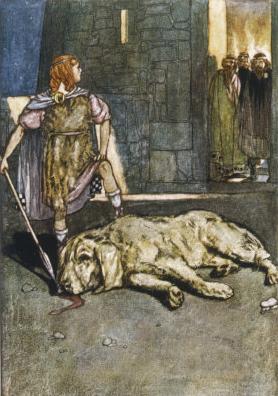 Place an image named cu-chulainn.jpg in the images/ folder to display it here.
The Ulster Cycle gives us Ireland's supreme hero: Cú Chulainn, son of the sun god Lugh, whose life is one long blazing arc from extraordinary promise to inevitable tragic end.
As a boy of seven, he killed the great hound of the smith Culann with his hurling ball, then offered to take the dog's place — accepting the name Cú Chulainn (the Hound of Culann) without complaint.
The Táin Bó Cúailnge
His greatest trial came during the Táin Bó Cúailnge (Cattle Raid of Cooley), when all of Ulster's warriors were struck down by a goddess's curse, and only Cú Chulainn stood between the province and destruction. He held an entire army at bay for weeks through single combat, fighting despite his wounds, despite exhaustion, despite supernatural interference.
His battle-fury, the ríastrad, made him terrifying beyond description — one eye sinking into his skull, his body twisting within his skin, heat rising from him in visible waves. Knowing his end was near, he bound himself to a standing stone so that he could die on his feet, facing his enemies. The ravens did not dare land on him until after he was dead.
"It remains the most defiant death in Irish literature: the image of a man who, faced with annihilation, simply refuses to fall."
The Banshee — Woman of the Fairy Mound
 Place an image named banshee.jpg in the images/ folder to display it here.
Of all the supernatural beings that emerged from Irish mythology, none is more immediately recognisable or more uniquely Irish than the Banshee — bean sídhe, "woman of the fairy mound." She exists at the boundary between the world of the living and the world of the dead.
She is not a bringer of death but a mourner — performing the ancient rite of keening on behalf of the Otherworld. She is bound by ties older than history to the families of old Gaelic lineage: the Ó Néills, the Ó Briains, the Mac Cárthaighs. To have a Banshee was, paradoxically, a mark of noble descent.
Her appearance varies — she may come as a beautiful young woman weeping beside a midnight river, or in her most ancient form, the Washer at the Ford, scrubbing the bloodied garments of those about to die. What never varies is the sound: a keen unlike anything a human throat can produce, rising and falling on the night air with a grief so pure and vast that those who hear it are struck dumb.
"The Banshee is, in the deepest sense, a figure of compassion: she mourns us before we know we are to be mourned."