The Matter of Britain — King Arthur & Camelot
The Matter of Britain is one of the three great medieval literary cycles. At its heart lies the story of King Arthur — a legend so vast and so enduring that it has been continuously retold, reinvented, and reimagined for over a thousand years.
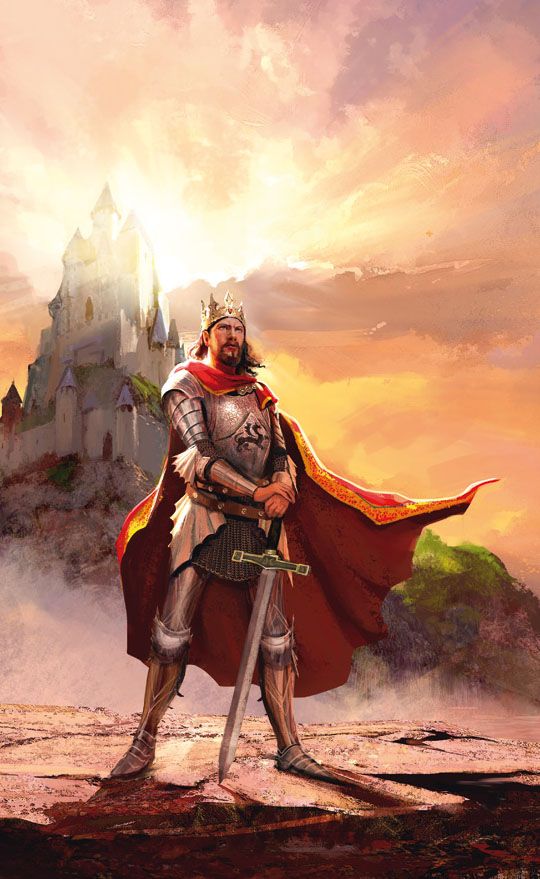 King Arthur by Charles Ernest Butler, 1903 — place an image named king-arthur.jpg in the images/ folder to display it here.
The Historical Origins of Arthur
Whether Arthur was a historical figure remains genuinely contested. In the fifth and sixth centuries CE, following the withdrawal of Roman legions from Britain, there may well have been a Romano-British war leader of exceptional ability who organised resistance against Anglo-Saxon settlers. The earliest reference to Arthur by name appears in the Welsh poem Y Gododdin (600 CE), which praises a warrior as brave "though he was no Arthur" — implying he was already a standard of heroic comparison.
Geoffrey of Monmouth transformed him into a legendary king in his Historia Regum Britanniae (1136), introducing Merlin, Guinevere, and Excalibur, establishing Arthur as a national symbol that would inspire authors across Europe for generations.
Camelot, the Round Table & the Quest for the Holy Grail
Camelot represents an ideal kingdom built on justice, unity, and moral excellence. The Round Table, introduced into the literary tradition by the Anglo-Norman poet Wace around 1155, is its most powerful symbol: a table with no head, no position of precedence, where every knight is equal to every other.
"Then was the holy vessel borne by angelic hands away from Britain, and since that time no man has been bold enough to say that he hath seen it." — Sir Thomas Malory, Le Morte d'Arthur, 1485
Merlin the Prophet
Merlin stands at the intersection of history, prophecy, magic, and tragedy — one of the most extraordinary characters in British mythology. He is two distinct Welsh figures merged into one: Myrddin Emrys, the prophetic boy, and Myrddin Wyllt, the mad bard who retreated into the forest to commune with animals. He embodies prophecy, wisdom, and the connection between the human world and the supernatural — an advisor who can see through time, yet is ultimately powerless to prevent the tragedy he foresees.
The Tragedy of Camelot
The downfall of Camelot is brought about not by external enemies but by the forbidden love between Sir Lancelot and Queen Guinevere, and the treachery of Mordred. It is not a story about the defeat of good by evil, but about the defeat of the good by the good — about how love, loyalty, and honour can be arranged in configurations that destroy each other.
Arthur does not die — not quite. He is carried to the Isle of Avalon, where he sleeps until Britain needs him most: Rex Quondam Rexque Futurus — the Once and Future King.
Key Figure: Lancelot
The greatest knight of the Round Table, whose love for Guinevere ultimately destroys the fellowship he devoted his life to protecting.
Key Figure: Mordred
Arthur's illegitimate son and ultimate betrayer — who seizes the throne while Arthur is at war and falls at the final battle of Camlann.
Robin Hood — Outlaw, Hero & Folk Legend
If King Arthur is the mythological ideal of legitimate authority, then Robin Hood is his great counterpart: the perfect outlaw, the man who refuses unjust authority and returns power to those from whom it has been stolen.
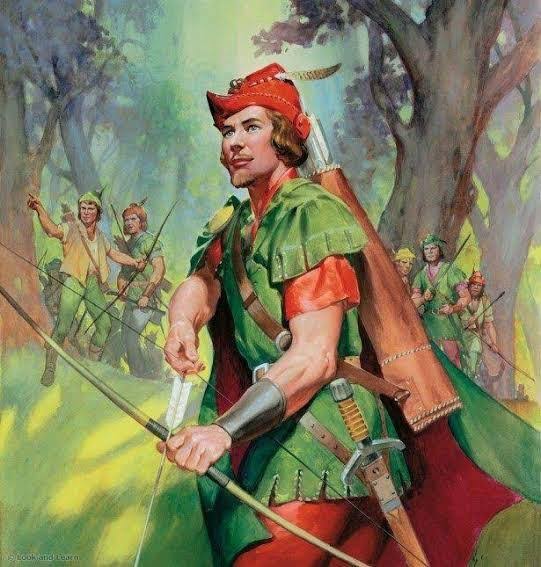 Place an image named robin-hood.jpg in the images/ folder to display it here.
Origins & the Ballad Tradition
Robin Hood is the most democratic of all English folk heroes — a man of exceptional skill with no divine ancestry or magical sword. A Robert Hood appears in legal records in York in 1226 as a fugitive, but the name "Hobbehod" was already being applied generically to outlaws. The earliest surviving literary treatments are the medieval ballads, chief among them A Gest of Robyn Hode (15th century).
The Greenwood & the Social Myth
Sherwood Forest is a space of radical equality — where no one asks your rank before feeding you, where skills matter more than birth. The legend has been adapted in every era: enlisted in arguments about land enclosure in the sixteenth century, reimagined as a dispossessed Saxon fighting Norman tyranny in the nineteenth, and a political radical in the twenty-first.
What never changes is the essential moral structure: power is corrupted, the law becomes its instrument, and a person of exceptional skill steps outside the law to restore justice. It is a myth for every age.
"Unlike Arthur, whose authority is divinely sanctioned, Robin Hood's heroism arises entirely from moral courage and intelligence, speaking to ordinary people across every generation."
Character Explorer
Browse the key figures from the Arthurian legend and Robin Hood.